
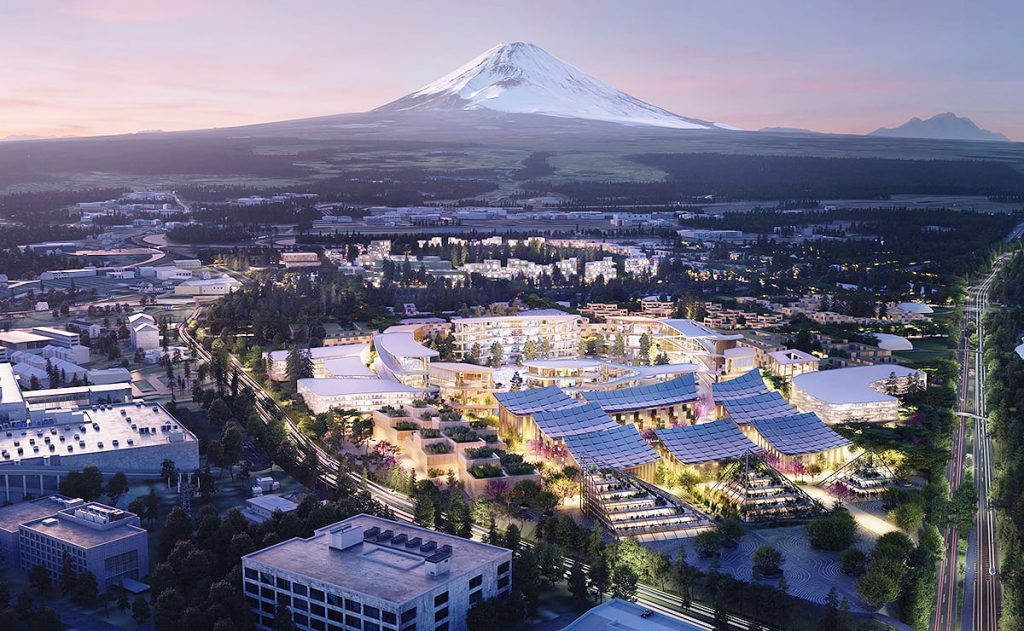
Aiming to facilitate the movement of people, goods, and information, Toyota expands its reach to serve humanity’s needs. Changing the way future societies live, work, and move is the focus of Japan’s futuristic city whose approach is based on three main principles: The first one is “human-centered” respect prioritizing people’s needs and preferences. The second principle is the “naturalistic lab” that enables regular testing of new technologies in the real world. The final criterion is an “ever-evolving” approach whereby such new technologies and services are continuously developed and improved.
The construction of a city from the ground up, even on a small scale like this, is a unique opportunity to develop future technologies including a digital operating system for city infrastructure. Buildings and vehicles are all connected. Also, they can communicate with each other. Akio Toyoda, the president of Toyota Motor Company, has asserted that through data and sensors, they will be able to test connected AI technology in both virtual and realistic domains so as to maximize its potential.
Toyota invites collaboration with other commercial and academic partners and invites interested scientists and researchers from around the world to work on their projects in this unique, real-world incubator.
Akio Toyoda said, “We welcome all those who are inspired to improve the way they live in the future to take advantage of this unique research ecosystem and join us in our quest to create an ever-better way of living and mobility for everyone.”
A multitude of different technologies has begun to fundamentally change the way we live and navigate in our cities. The advent of connected, autonomous, emissions-free, and shared transportation systems will certainly open up a new world of possibilities for urban living. With the rapid growth of technologies and the industries that we have been able to access and collaborate with through the ecosystem of Toyota companies, we believe that we have a unique opportunity to explore new forms of urbanization with the futuristic city of Japan, which can pave new ways for the investigation of other cities.
The purpose of creating Woven City
The idea of this city is that all people, vehicles, and infrastructure can communicate with each other through real-time data and embedded sensors. This connection will allow Toyota to test the functionality of advanced AI technology in the real world with minimal risk.
Who lives in Woven City?
Toyota’s concept of Japan’s futuristic city will start with 360 residents, mostly senior citizens, families with young children, and inventors, and according to plans, its population will reach 2,000 or more including Toyota employees. Conceived as a “living laboratory,” the Woven city serves as a home to residents and full-time researchers who are able to test and develop technologies such as autonomy, robotics, motion planning, smart homes, and artificial intelligence in a real environment.
Residences will be equipped with the latest human-support technologies such as in-home robotics to assist people in their daily life. Using sensor-based artificial intelligence, these homes examine residents’ health, satisfy basic needs, and enhance daily life, which can give rise to the safe and positive deployment of connected technology.
To move residents within the city, only fully autonomous and zero-emission vehicles will be allowed on major thoroughfares. In Woven City, Toyota’s stand-alone electronic pallets will be used for pickup and delivery as well as for changeable mobile retail.
Both local parks and a large central park for recreation, as well as a central plaza for assemblies, are designed to bring the community together. Toyota believes that encouraging human connection will be an equally important aspect of the experience.
What is the location of the Woven City?
Toyota begins the construction of a high-tech “Futuristic City of Japan” at a former vehicle manufacturing factory on Mount Fuji in Japan. The development was first announced in January 2020 as a “prototype of the city of the future where all ecosystems are connected”.
What is the main source of energy for Japan’s futuristic city?
Japan’s futuristic city is a fully connected ecosystem powered by clean energy sources such as hydrogen fuel cells, solar power, and geothermal energy.
Using traditional Japanese wood joinery combined with robotic manufacturing methods, the city has been planned to be fully sustainable with buildings made mostly of wood to minimize the adverse impacts of carbon. The roofs are covered with photovoltaic panels to generate solar energy in addition to the energy produced by the hydrogen fuel cells. Toyota plans to weave open spaces throughout the city with native vegetation and hydroponics.
In the next article, we will discuss more about this city. So, please stay tuned with us.